Reset
Inverting the Ballet Practice

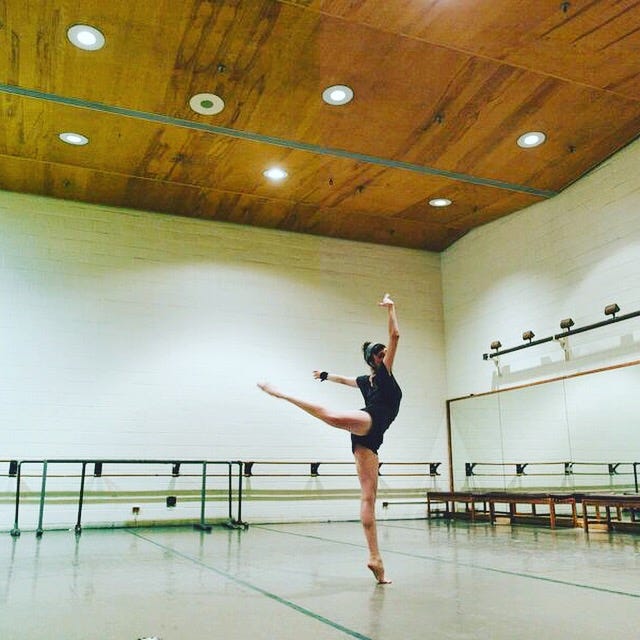
I have been training in ballet day after day for many years. I love that the consistency of the practice allows me to notice subtle changes in myself. But my body knows these patterns and shapes so well that I can now get through a ballet barre without breaking a sweat and activating only a few muscles. My bones, tendons and ligaments just flow through the familiar shapes. This can be great, but also has downsides. In ballet you are almost exclusively working with your legs and arms in “turn out” and “outward rotation”. This is a particular way of organizing your posture and movement patterns so that you are always rotating your arms and legs in outward directions that align into the elegant ballet aesthetic. These patterns are completely unnatural for most human bodies and require tremendous effort and concentration for beginner ballet dancers. But now that my body has trained for so long and knows these patterns so well, and can do this without muscular effort, it has actually become somewhat dangerous for my connective tissues. Without the muscles activating around the joints to protect them, it puts continuous strain on the ligaments and tendons to support the joints. So… what to do?
I have discovered a reset technique I find very useful. Every few months I will devote a week or so of my ballet training to completely reversing the “turn out” and “outward rotation” patterns: I will do ballet classes completely “turning in” my legs and arms and activating “inner rotation”. It looks rather ugly, but feels amazing. Many dancers use various techniques to cross-train and strengthen different muscles to support their dancing. But I am maybe the only person who I have ever seen doing an entire ballet class turned in with inner rotation. It activates all the stabilizing muscles that are opposite of what are usually being used for ballet and gives a stretch to joints and places that typically become tight. I find that going through the entire sequence of a ballet class like this, helps me to give these muscles and coordinations the same level of refinement that their counterparts receive in a normal approach to ballet.
My whole body wakes up and feels stronger. I am tired and sweaty by the end of barre. And when I get to the larger movement combinations in the center of the room, I have much more balance and play available to me. My range of movement feels wider and broader. I can stretch the timing and musicality of things with more dynamic range. With just a few days of this inward rotation cross training, I find my dancing improves very quickly.
It is a reset. It jumpstarts me back into a more virtuosic way of dancing when I’ve been feeling stuck, or accumulating overuse injuries.
To do this requires some bravery on my part. I am going against every single rule and norm of a ballet class. I risk the perception of “being bad at ballet” or “not understanding the technique”. I risk annoying a teacher who is giving instructions about how to dance in “turn out”. One teacher (rather famous in the ballet world) asked me if I was planning on doing the combinations he was presenting, not realizing I was actually meticulously doing his exact combinations, but just with reversed rotation.
Sometimes I’ve tried to explain what I am doing to my teachers, so as to clarify that I am not trying to defy their teachings, but rather use the wisdom of their class coordinations in a way that can be most useful to my body’s current state. I’ve rarely found that the teachers I’ve tried to talk about this seem to have the interest or patience to discuss this. Which is fine. I’ve come to trust my own knowledge of the usefulness of this practice, and I just pray l they are not too offended by my dancing in this way every so often.
Going against the grain, while still participating in the system of ballet class, is very useful for my health and well being. And makes me a better dancer. But it involves some interpersonal risk.
I’m ok with that and feel confident enough and well established enough as a dancer to take these risks, but it makes me think about where else these kind of resets and re-evaluations of norms might be useful. Particularly how can we go against the grain in ways that are useful for healing, while remaining inside systems?
If you have any thoughts or examples to share, would love to hear them.